The 15-Minute Protocol That Eliminates Dental Practice Chaos
Jun 10, 2026
Every morning in my practice, before a single patient walks through the door, my entire team gathers together for exactly 15 minutes. We sit in a circle — every hygienist, every assistant, every front desk coordinator — with a large shared screen in the center displaying the day ahead. We review what happened yesterday, prepare for what is coming today, and we end with something most practices would never think to include. Then we open the doors.
It sounds simple. It is simple. And yet fewer than 20% of dental practices do anything like it.
I have been running this morning huddle for years, and I am convinced it is one of the most important things we do. Not because of what it produces in terms of revenue — I do not even discuss daily production goals with my team — but because of what it produces in terms of people. A team that starts the day together, with clarity and intention, is a fundamentally different team than one that arrives in dribs and drabs, still carrying the weight of the morning commute.
The Problem Most Practices Are Solving for the Wrong Way
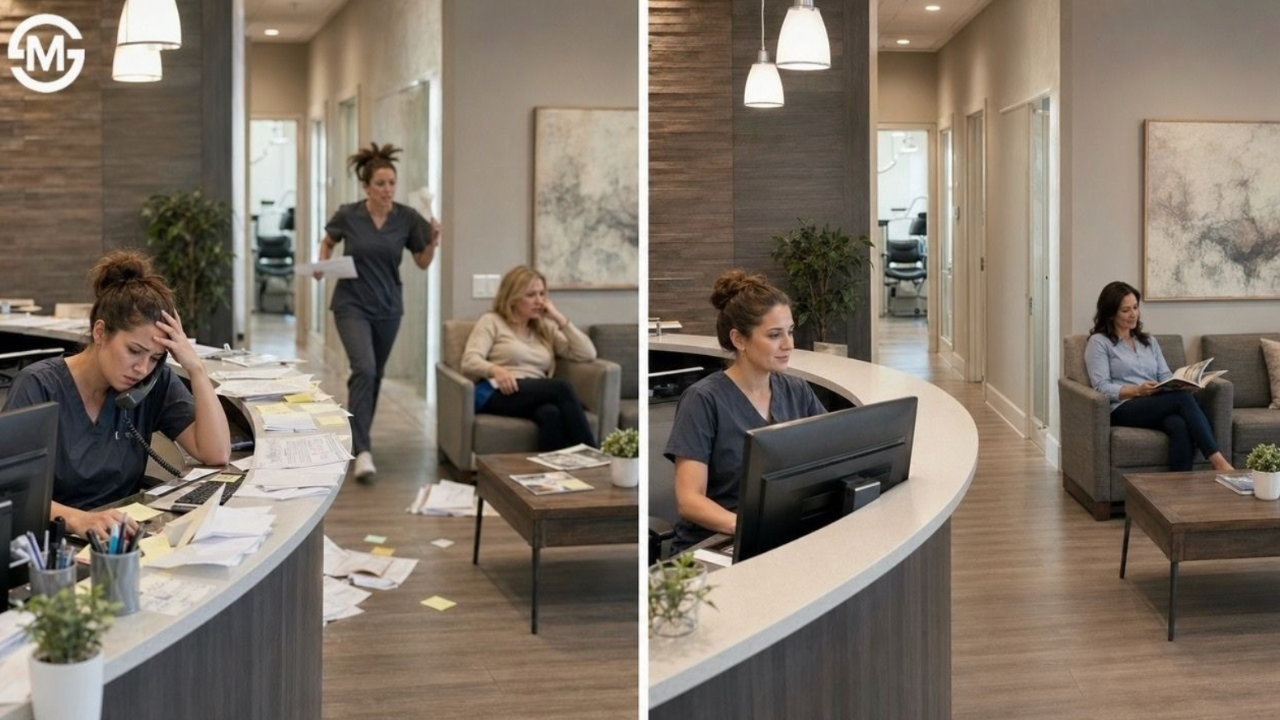
When a dental practice feels chaotic — when the day starts late, when clinical details fall through the cracks, when staff morale is low — the instinctive response is to push harder. Set higher production targets. Demand more accountability. Tighten the schedule. I understand that impulse. I have felt it myself.
But in my experience, pressure without preparation does not create performance. It creates stress. And stress is contagious. When one person walks in flustered, it ripples through the entire team. By the time the first patient is seated, you are already behind — not on the schedule, but mentally. The whole day is spent catching up to a version of the morning that never quite arrived.
The morning huddle is the antidote to that cycle. It is not a meeting about money. It is a meeting about readiness.
What We Actually Cover in 15 Minutes
The structure of our huddle is deliberate. We move through three phases, and each one serves a distinct purpose.
We begin by reviewing yesterday. What went well? Were there patients who waited too long? Were there staff conflicts that need to be addressed? Did we handle an emergency gracefully, or did it throw us off? This is not about blame — it is about learning. If something went wrong, we acknowledge it and decide whether it needs follow-up. If something went right, we name it. People need to hear when they did well.
Then we turn to today. We go through the schedule together, looking at every appointment with fresh eyes. Are there openings we can fill? Do we have new patients who need CBCT scans or specific x-rays? Are the hygienists set up for their probing appointments? Most critically — and this is the one that saves us from the worst kind of morning chaos — we verify that every lab case we are expecting to deliver today is physically in the office. Not assumed to be there. Confirmed.
Finally, we close with something that might seem frivolous but is, in my view, essential: we laugh. We have a calendar of terrible dental puns — the kind of jokes that make you groan before you smile — and a different team member reads one out loud every morning. We follow it with a short inspirational thought. And then we open the doors.
Why I Do Not Talk About Production in the Morning Huddle
This is the part that surprises people most.
I run a high-production practice. We have partners, hygienists, and a full administrative team. Production matters. But I made a deliberate decision long ago not to use the morning huddle as a production meeting. I do not put daily revenue targets on the screen. I do not tell my team what number we need to hit. I am not a harsh taskmaster, and I do not want my team to start the day feeling like they are on a quota.
Here is what I have found: when people feel prepared, when they feel like part of a cohesive team with a shared purpose, production takes care of itself. The stress that comes from chasing a number is far more damaging to performance than the absence of a target. My team does not need a financial goal to motivate them. They need clarity, connection, and confidence that the day is under control.
That is what the morning huddle gives them.
The Football Analogy That Changed How I Think About This
A football team does not walk out onto the field five minutes before kickoff, put on their uniforms, and start playing. They arrive hours early. They stretch. They review the game plan. They watch film. They have a locker room speech. By the time they step onto the field, they are already in the game mentally.
A dental team is no different. We are performing at a high level under pressure, managing complex clinical situations, and caring for people who are often anxious or in pain. We owe it to our patients — and to each other — to show up ready. Not just physically present, but mentally prepared and emotionally grounded.
The 15-minute huddle is our locker room. It is where we become a team before the doors open.