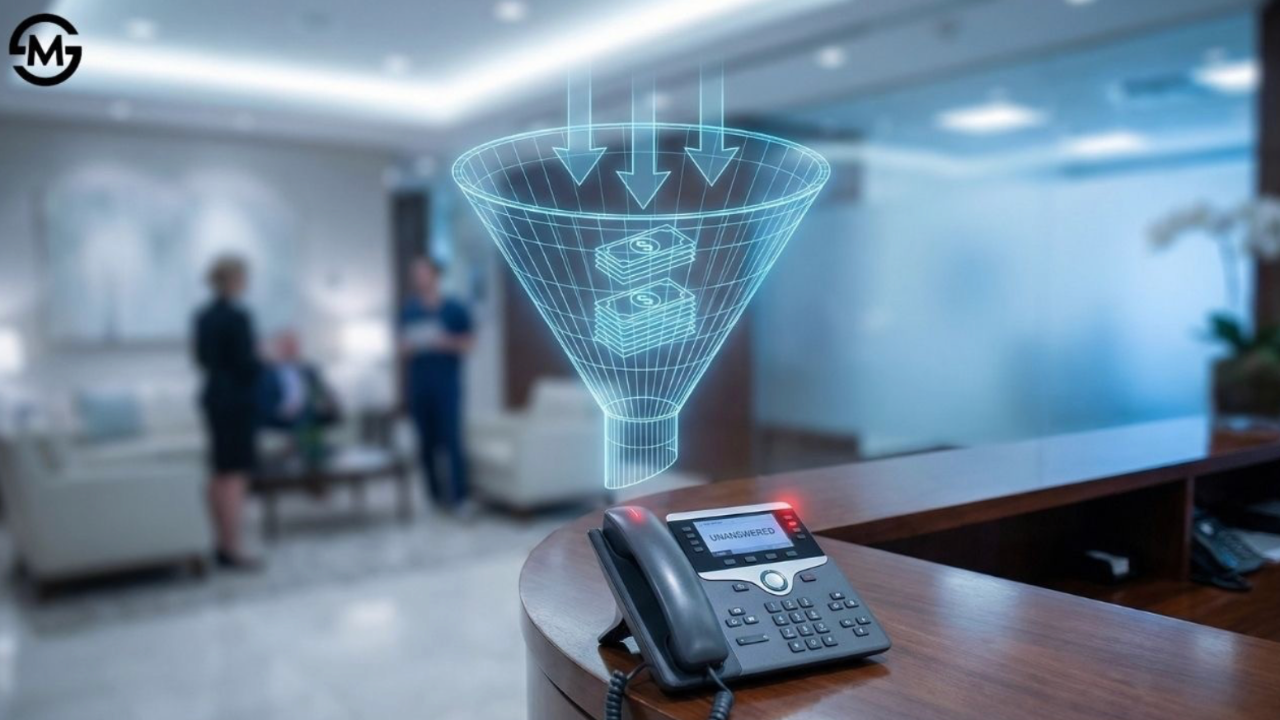
The "Anti-Sales" Team Destroying Your Practice Growth
Mar 31, 2026We spend tens of thousands of dollars on marketing. We optimize our websites, run ads, and obsess over SEO. We do everything in our power to get the phone to ring.
And when it finally does ring, we assume our highly trained front desk team is ready to convert that lead into a lifelong patient. We believe that efficiency and automated systems are the key to handling volume.
But I've discovered a terrifying reality in practices across the country. The very team you hired to build your practice is inadvertently acting as an "anti-sales" force. They are actively destroying the most precious commodity your patients possess: their time. And they are doing it within the first few seconds of a call.
The Disconnect Between Efficiency and Connection
I've watched highly successful practices hemorrhage new patient opportunities. It's not because their clinical skills are lacking. It's not because their marketing is ineffective. It's because of a catastrophic failure at the exact moment a patient decides to reach out.
We rely on industry-standard protocols that actively alienate callers before they even speak to a human being. We use systems designed for our convenience, completely ignoring what the patient actually craves when they contact us.
The phone is not just a tool for communication; it is primarily a tool for connection. Connectivity is the most important thing human beings want when they are talking to another human being. Yet, many front desk teams inadvertently act as an "anti-sales team." Their default behavior is to block business by immediately putting people on hold or forcing them into automated systems.
The "Phone Tree" Fallacy
Consider the standard phone tree. Practices use phone trees for their own convenience, not the patient's. Forcing a patient to listen to an infomercial or navigate options (e.g., "Press 1 for insurance, Press 2 for prescriptions") is insulting to someone seeking immediate help. I recently observed a practice with three staff members sitting at the front desk, yet they still forced callers through a 4-option automated phone tree, wasting 35 seconds of the caller's time before a human ever spoke.
Time is a human's most precious commodity. No matter who you are, you can't create more time. Forcing a patient to wait on hold or navigate a phone tree wastes their time and immediately generates frustration. It's almost as if we are saying, "Please, no business, we don't want any business, we want to keep you away."
Furthermore, many offices close their phones for an hour between 12:00 PM and 1:00 PM for lunch. This is exactly when patients are on their own lunch breaks trying to make appointments. We are making it as difficult as possible for people to give us their business.
The 30-Second Rule: A Framework for Phone Etiquette
There is a counterintuitive approach. A simple, overlooked secret that completely transforms how a practice operates. It requires zero new technology and costs absolutely nothing to implement.
Here is the framework I use to ensure the phone becomes an engine for growth rather than a source of frustration:
- Answer the phone pleasantly. The tone of voice sets the stage for the entire patient relationship.
- Answer within 30 seconds. Speed is a proxy for care. A prompt answer demonstrates respect for the caller's time.
- Never put anyone on hold automatically. The immediate "Please hold" is the ultimate anti-sales tactic.
- Give them the option. If you absolutely must put them on hold, apologize, explain you are busy, and give them the option: ask if they prefer to hold for a specific, short amount of time (e.g., "Can you hold for exactly 30 or 40 seconds?"), or if they would prefer a call back.
The Power of Simply Answering
I've seen businesses outside of dentistry use this exact same methodology to dominate their markets. Dan White, a highly successful roofing contractor, built his competitive advantage simply by actually picking up the phone when people called him. Pete Doyle, an elite insurance salesman in NYC, made it a point to call people back immediately, establishing a strong human connection that set him apart from his peers.
When you stop treating callers like a nuisance to be managed and start applying this framework, the phone transforms from a source of daily stress into your greatest engine for joy and referrals. Don't miss that opportunity. The phone call is one of the greatest ways to give your patients great service.
Dr. Michael Sonick is a periodontist and implant specialist based in Fairfield, Connecticut. He is the host of the podcast, The Art of Hospitality in the Dental Practice, and a recognized authority on practice growth and patient experience.
If you haven't read Dr. Sonick's book, Treating People Not Patients, you can get it here.